

I Walked Out of Chapel Today
Experiencing Scripture as an Intersectional Person


Tripp Hudgins and I have begun exchanging letters to gather our thoughts and challenge one another. We chose to post them in this way in the hopes that they would be an encouragement and catalyst for you as well. Because we need each other. You can find the rest of the conversation here:
What’s up, Tripp Hudgins .
I know it’s technically your turn to respond in our correspondence, but something happened today and we should talk about it.
We read 1 Thessalonians 2:14-20 in noon chapel and I had to walk out.
And we also thank God constantly for this, that when you received the word of God, which you heard from us, you accepted it not as the word of men but as what it really is, the word of God, which is at work in you believers. For you, brothers, became imitators of the churches of God in Christ Jesus that are in Judea. For you suffered the same things from your own countrymen as they did from the Jews, who killed both the Lord Jesus and the prophets, and drove us out, and displease God and oppose all mankind by hindering us from speaking to the Gentiles that they might be saved—so as always to fill up the measure of their sins. But wrath has come upon them at last!
“I had to walk out” can mean a lot of things depending on who’s saying it. For me, it wasn’t a crisis of faith or a bad week. There is a history of blood attached to those words, and my body made the interpretive decision before my head caught up. I wonder how it looked to see Lana walk out both laughing and crying at the same time.
Verses 15 and 16 stack an extraordinary set of indictments against “the Jews”: killing Jesus and the prophets, expelling the apostles, displeasing God, and being “hostile to all people.” That last phrase, πᾶσιν ἀνθρώποις ἐναντίον (pasin anthrōpois enantíon), echoes antisemitic tropes later used by Tacitus to frame Jews as cosmic enemies of humanity. If all of that is not enough, this passage ends with “the wrath has come upon them at last.”
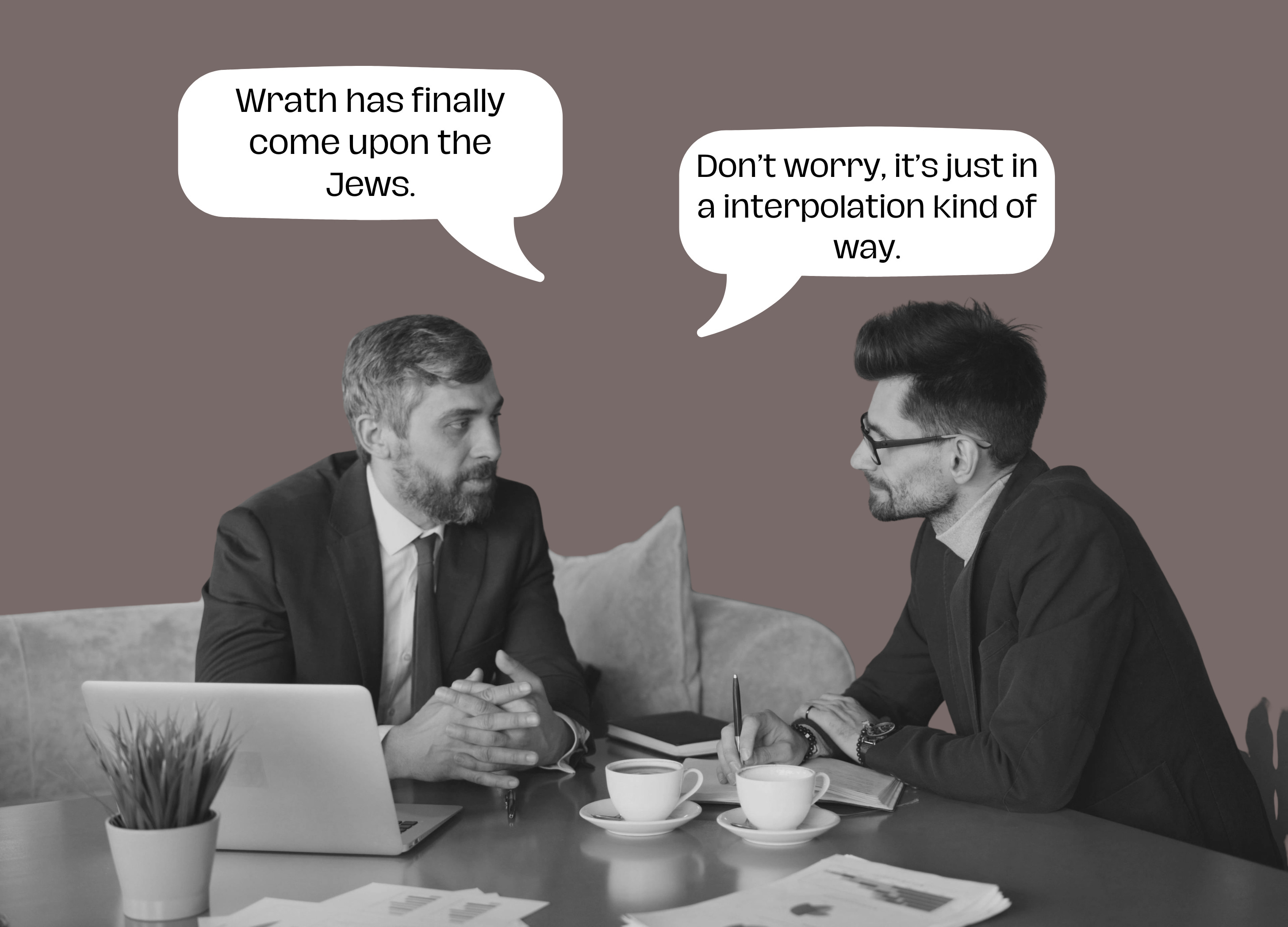
Of course, we can go through mental gymnastics like the interpolation argument that Birger Pearson and others have made. Interpolation, for the readers who are unaware, is a passage that scholars believe was inserted into a text by a later editor or copyist, rather than written by the original author. In this case, it states that verses 14-16 are a non-Pauline addition written after 70 CE, because “the wrath has come” reads retrospectively, the tone contradicts Paul’s anguished tenderness toward his own people in Romans 9-11, and the manuscript tradition cannot definitively settle when these verses entered the text. (I think I ironically made a Paul-length sentence there, ha.) If the interpolation holds, Paul didn’t write this. I’m going to be real with you, Tripp, that would be clarifying, in the way that learning a wound was accidental rather than intentional is clarifying, without actually healing anything.
There’s also the intra-Jewish polemic reading, which I take seriously. Paul was himself a Jew writing in a moment of intra-community conflict, and the genre of fierce denunciation between Jews is well attested. This is especially apparent when we look at the Qumran discovery, specifically in ‘The Community Scroll’ and ‘the War Scroll,’ where the authors mince no words when they attack their fellow Jews. They call them “sons of darkness” and even “the lot of Belial.” Calling this antisemitism may apply a modern category to an ancient intra-Jewish dispute. I can hold that argument in one hand and still not be able to go back into the room with the other.
My gripe with all of this is that none of that matters. Meaning comes from how a text functions within the whole web of a community’s life, and not from authorial intent. Lindbeck would argue that doctrine shapes formation at a pre-reflective level, and people do not consciously choose what the text instills in them. So doctrine functions as a grammar for us to understand text and just like our every day grammar, we don’t think about it, we just use it.
Let me say this with a less theological bent. Our mental models predetermine what the text means. We have receipts for this: language like this was used as the basis for the antisemitic rhetoric in the works of historian Tacitus, it was also used during the Rhineland massacres, and again… how can we forget… in 1939-1945.
It has authorized contempt, violence, and the deaths of Jewish people across centuries of European Christian history. An appeal to first-century grammar cannot launder the twentieth-century function, because the grammar changed! The text was re-grammaticalized inside a system where Jews were a subordinated out-group rather than co-religionists in dispute, and that is the text we now have.
I think even more damning, the hearers do not neutralize the grammar by knowing the interpolation theory, because the grammar operates below conscious thought, which is precisely what Lindbeck told us. People are formed by the grammar they inhabit, not by the footnotes. Requiring graduate-level textual criticism to undo the formation a text is doing in real time is not a pastoral burden we can reasonably place on anyone.
Of course, Lindbeck also didn’t have a great answer for what to do when the grammar itself is corrupted. He was much better at describing how grammar works than at adjudicating when one needs to be broken. For that you’d need someone like Willie Jennings on the racially deformed Christian imagination, or Elisabeth Schüssler Fiorenza’s hermeneutics of suspicion, doing work Lindbeck left undone.
So what do we do?
I can’t answer that for you, Tripp. But what I can offer is three questions intersectional theology demands that we ask.
Who is being harmed by this text’s continued use, and are they in the room?
Not who was harmed historically, but who bears the weight of it now and whether the people with the most standing to answer that question have any power over whether it stays in the lectionary.
Whose suffering is being centered, and whose is being instrumentalized to explain it?
In this passage, Gentile Christian suffering is the subject. Jewish behavior is the explanatory frame. An intersectional reading asks who gets to be the subject of their own story and who gets flattened into a plot device in someone else’s.
What is this text forming in people who can’t be expected to bring a commentary with them to the pew?
Drawing directly from Lindbeck, if religious language shapes people at a pre-reflective level, the question is what it does to ordinary people absorbing it as sacred, authoritative, and read aloud in a worship context.
An intersectional reading teaches us that the rhetoric of “hostile to all” has a pattern. This kind of accusation, that a minority group is a threat to the whole of humanity, is the template for racialized scapegoating. You see identical logic applied to Jewish communities in medieval Europe, to Black communities in America, to queer people in Christian nationalist discourse. Reading it intersectionally means recognizing the structure of the argument as dangerous and independent of its specific target.
If you take a liberationist hermeneutic seriously, you have to be willing to say: some texts in the canon have been, and continue to be, instruments of oppression, and reading them “charitably” without naming that is itself an act of political violence.
We could of course just ditch it from the lectionary. But I like what Hayden Hobby said when I talked to him about this. Just ditching it and refusing to look at it is the same as the bigotry Christians display when they conveniently leave out the verses that demand that we welcome the immigrants.
I think another way forward is to name the harm the text has done and continues to do. This gives us the opportunity to add liturgy to our lectionary and it allows us to repent.
“Creator, we confess that the text that we are about to read has been used to justify hate in the name of Jesus…” How would that prayer end, Tripp?
With love,
Lana
 | A guest post by
|
Thank you. I so appreciate following your efforts to think critically about the words we use when we approach the Divine (in each other as well as in the Absolute). It is too easy to keep doing what we've always done - noticing the ways in which we have lost the ability to see and hear the effects of our actions on others is crucial to a life of faith.
Thank you for this - it's so needed.