

On the Precision of Language
From Confession to Commission


Tripp Hudgins and I have begun exchanging letters to gather our thoughts and challenge one another. We chose to post them in this way in the hopes that they would be an encouragement and catalyst for you as well. Because we need each other. You can find the rest of the conversation here:
Good evening, Tripp.
I hope that you’ve had at least one quiet moment this week that was just yours. I worry about you every now and then, especially when I see a post dated at 4 AM. We all need sleep!
There are two things that I want to touch on:
1. The importance of your lived experience when it comes to liturgy.
2. Clarifying intersectionality, or at least what I mean by it.
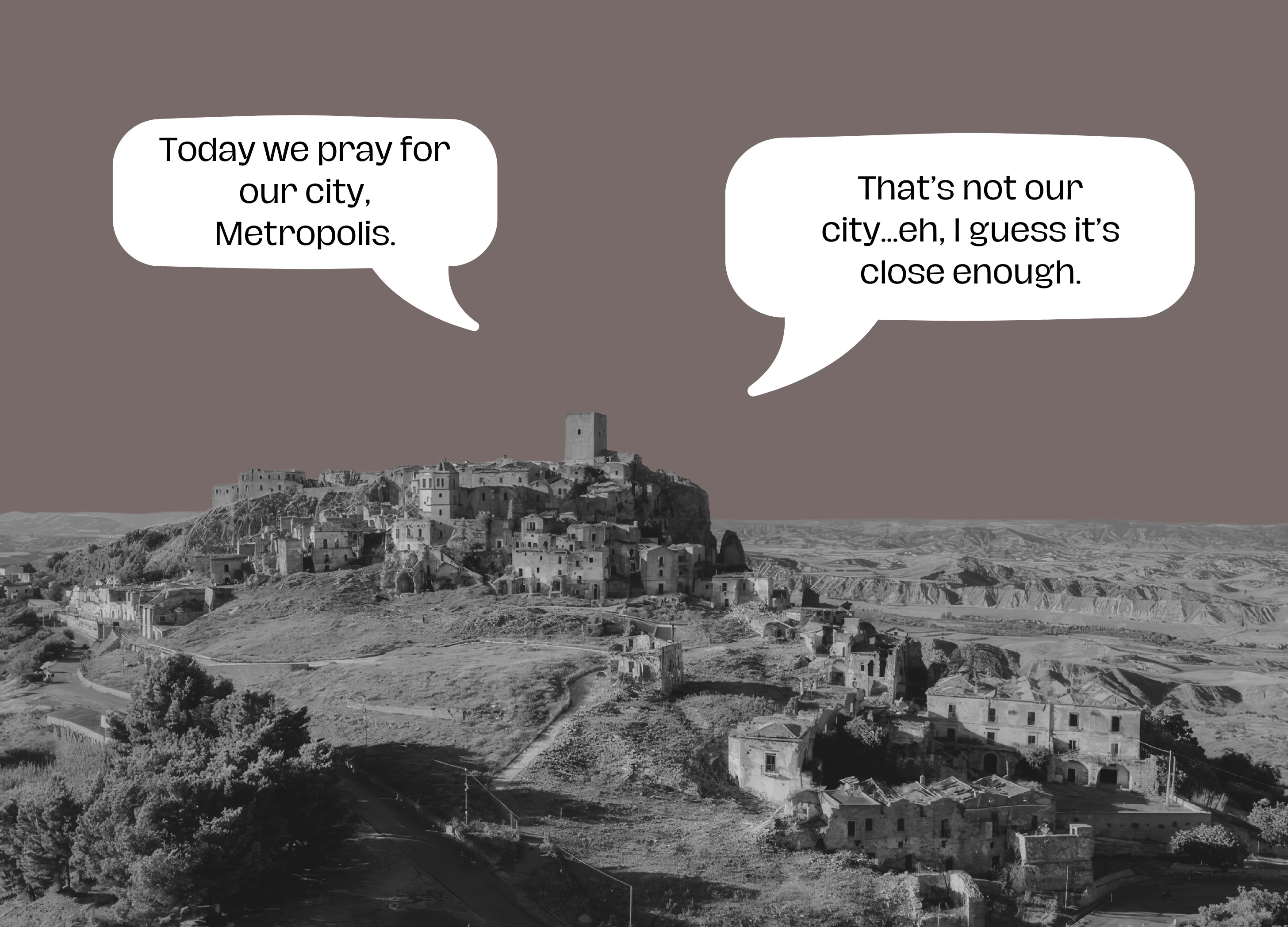
I’ve been sitting with your letter since it came in, and I want to say first that your deep understanding of liturgy is what I think these letters between you and me need. You can reach into the body of Christian prayer and pull out language that is already communal and confessional and also aimed at something bigger than the two of us writing to each other. I’m always surprised how you can pull one of those liturgical prayers out of a proverbial hat. Next thing I would like to see is how your understanding of those prayers can be converted into our community of being ‘a small city upon a hill’. Not in the John Winthrop sense, but in a communal sense.
Which brings me to the Casa De Sol Prayer that you mentioned. I have noticed that we often use that prayer at the end of the service at Richmond Hill, and I love it. Although I do wonder why a Canadian/Scottish scholar used “Casa Del Sol” instead of “Taigh na Grèine.”
Hold that thought, I’m just now finding out that John Philip Newell served as a Companion Theologian for the American Spirituality Center of Casa Del Sol at Ghost Ranch in Abiquiu, New Mexico. So it should be “The Prayer of Jesus that we pray at Casa Del Sol,” not “The Casa del Sol Prayer of Jesus.” Tripp, did you tell your readers already that I have pretty severe ASD and that you run into these brain farts of mine on a regular basis? I digress.
Back to the prayer. When I pray that prayer at Richmond Hill, I feel moved. I recognize the undeniable inspiration of the Lord’s Prayer, and I see the necessity of changing the language. Jesus’s context is just different from ours. To just copy and paste what Jesus prayed feels… wrong. If the prayer were immutable, wouldn’t Jesus just pray “Hear, O Israel?” I say this because I can already dream up the angry comments, calling me a heretic for changing Jesus’s words. But Jesus’s words were culturally tainted and inevitably affected by the mental models that gave even Jesus an edge of misogyny.
Can we get to a place where we’re comfortable saying that out loud? I mean, if God came down and incarnated into the body of Jesus, I have to believe that Jesus was fully human with all the consequences that come with that. It means that Jesus probably didn’t know right away that he was an incarnate God. It means that he didn’t use special tricks to make his life easier… that would be cheating, right? It also means that he had the mental models of every person in that culture and would be capable of sin. I know that most will disagree with my last assertion, but I’m ok with that.
Now into the necessity of precision when it comes to the usage of the word intersectional.
You used the word intersectional in a few places in your letter, and I think we need to be more careful with it. Not because you used it wrong in some academic sense, but because intersectionality is a term I use with a specific meaning in my own writing, and I think our readers deserve that same precision here.
Intersectionality, as Kimberlé Crenshaw named it, and as I use it, describes what happens when someone holds multiple marginalized identities at once. The way that being trans and a person of color is not simply “trans + person of color” added together, but something distinct that neither category fully accounts for.
For example, a bi-racial person who is also trans is intersectional; their experience of racism and transphobia compound in ways that neither “this is about race” nor “this is about gender” fully captures. But two privileges held by the same person don’t produce an intersectional experience because they just produce advantage at multiple axes. The term was designed to name a specific kind of erasure that single-axis thinking (fighting racism or fighting sexism) can’t fully encompass.
So when you write that “new beginnings are intersectional,” or that “all of our privileges, our sins, our identities are intersectional,” I think I understand what you’re reaching for. Do you mean something like: it’s all connected, it’s all complex, none of it is separable? Because that is absolutely true but also not quite my working definition of intersectionality. A person or a liberation framework can be intersectional. But our privileges, taken together, are not intersectional. They’re just... multiple.
When intersectionality becomes a word for everything overlapping, it loses the thing that makes the term useful. If we stretch it to include the intersection of privilege and sin and identity generally, we risk making it yet another abstraction layer. It will just become a warm, inclusive-sounding word that gestures at complexity without doing the work of naming whose complexity, and at what cost.
So, I want to sit with your title for a moment. I love what you’re trying to say with Confessing the Intersectional Body of Christ. I believe Christ’s body held real margins like being Jewish under Roman occupation, being poor, being associated with the disreputable and touching the untouchable. But “intersectional” as a universal claim of intersectionality of the proverbial body of Christ moves in the opposite direction from where we need to go.
This of course also touches on the need for precision when we use Christianese words. In this context, is the body of Christ the believers, his actual body, or both? Regardless, it will change the meaning of your entire piece.
Which brings me back to Richmond Hill. You said it: we are always in conflict, whether we know it or not. And I think the liturgy you brought into this letter, as gorgeous as it is, can function like all beautiful liturgy: it can summon us to the work, or it can substitute for the work. So that leaves me wondering about how we can prevent that from happening. Can we prevent that from happening?
It makes me think about the dude you mentioned, Ion Bria, and his concept of the “liturgy after the liturgy.” His argument was that the Divine Liturgy doesn’t end when the service does because the dismissal, ”Go in peace,” is not a conclusion; it’s a commission. I have to sit with that for a bit because this means that the Eucharist is incomplete until it’s lived out in the world. It means that worship shapes the ethics; what happens at the altar has to continue in the street.
I really want to believe what Ion said. But we have said “go in peace” for a long time and yet here we are… still struggling to do the work. Do we just admit defeat and ditch the commissioning? Do we stubbornly hold on to it? They both feel like… meh. I would love to hear your thoughts on it because I want to know how we can move beyond creedal and confessional.
As always, with love and a little pushback,
Lana
 | A guest post by
|
I wish I had your brain.
Laura B.💕