

Systems Critique
And why I refuse the frame


A few weeks ago, I posted something tender on Substack. I said I was about to get facial feminization surgery and invited people to ask what they were too afraid to ask. I meant it, and I wanted to be emotionally available, not defensive. Then the first “question” came in, and my whole body clocked it before my brain did. I got sweaty, and I felt that quick little drop of anxiety, the one that makes you instantly regret posting anything at all and want to crawl away from your own words. And right there, before I answered a single sentence, I could feel the trap. The question was not really a question. It was a courtroom that wanted me to take the stand.
I’m happy to answer questions, but I’m not going to start from the assumption that the choice of surgery is inherently shallow or faithless. Before I answer, I need to name the frame I’m being asked to accept, because I don’t share it.
This is the move I’m trying to practice more consistently now, and it is called Systems Critique. When I say Systems Critique, I’m borrowing a posture older than me: Kierkegaard’s refusal to rest inside the System, and Foucault’s tracing of how power produces the self. What I add is the space between them.
What is Systems Critique
Those who’ve been reading my rants longer than today know that I strictly adhere to Systems Critique. In short, I first investigate whether I agree with the system a certain belief lies in. And there’s always a system underneath any belief. Please don’t read this as if a system is a bad thing, because it’s agnostic. It just is.
For example, we talk about a passage in scripture as if it floats above the system that produced it. We argue about “what the author meant” as if meaning is just a private opinion, sitting in someone’s head, untouched by audience, power, and incentive. But texts are not written in a vacuum. They’re written inside systems (religious systems, political systems, social systems), and those systems train all of us to hear certain lines as permission slips.
That’s why “Systems Critique” matters. If you don’t see the system, you will end up defending or attacking a position you don’t even hold. You’ll be arguing inside someone else’s frame (sometimes an empire’s frame, sometimes a church’s frame, sometimes a culture-war frame), and the frame will quietly decide the verdict before you ever get to your point.
I’ve given examples in the past about trans women in sports. If someone says, “it’s unfair that trans women join women’s sports,” it sits within a system. This system believes in fairness and thinks that trans women have an unfair advantage. It’s so tempting to start a list of arguments about hormones, bone density, or even the number of trans athletes. But every defender of trans rights needs to understand that by doing so, they quietly agreed to the system that lays underneath it. The defenders argue that it is fair that trans women join sports. But I’m here to argue that I disagree with the system completely. Sports is NOT a celebration of grit and hard work. Sports is a celebration of inequality.
LeBron is 6’9”, and he therefore has a genetic advantage over someone who’s 5’5”, full stop. Of course, I can see the keyboard warriors already getting their ammo ready to talk about Boykins, Webb, and Bogues, who were all successful 5’5” NBA basketball players. But the fact that we remember those players underscores how unusual this was. Just look at the scatter plot I made based on the data of the current 587 NBA players. Competitive basketball is a celebration of genetic inequality, not a celebration of grit and hard work.

Competitive sports is also a celebration of inequality when it comes to wealth. I’ve created a scatter plot with medals earned per country and GDP, and GDP per capita. Here you can see that the higher the GDP, the higher the medal count is (the larger the circle).
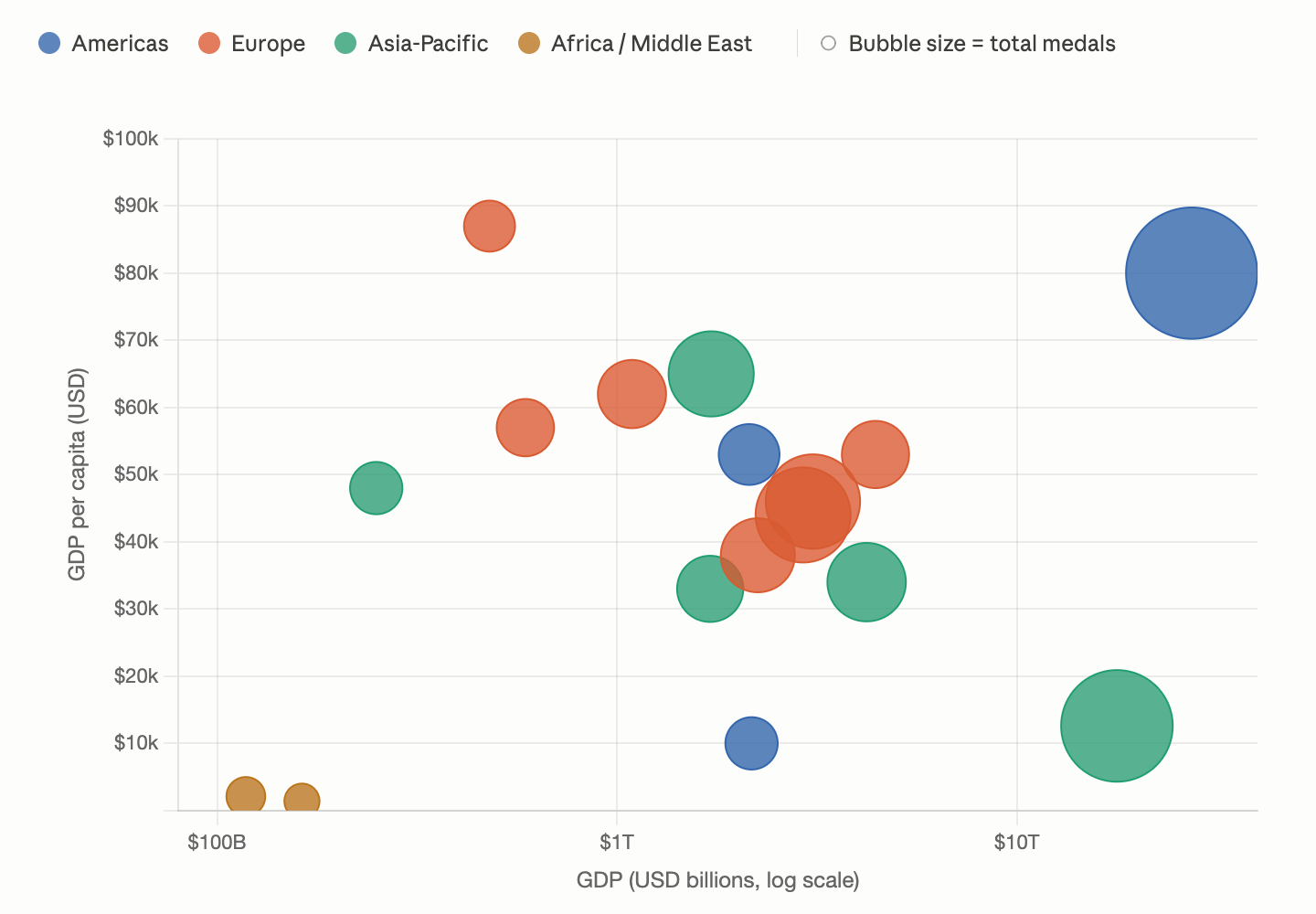
What Systems Critique does is expose that we’re not talking about the same thing at all. Both wealth and genetic inequality are deciding factors in success in sports. The exact same goes for sports in high school. Who do you think has a higher chance of success: the person who has access to their parents’ wealth and time, or the person who has been raised by a single parent with wealth disparity? Yes, I made a chart for that as well based on data I found in a Bureau of Labor Statistics study. The pipeline is real, dear readers.
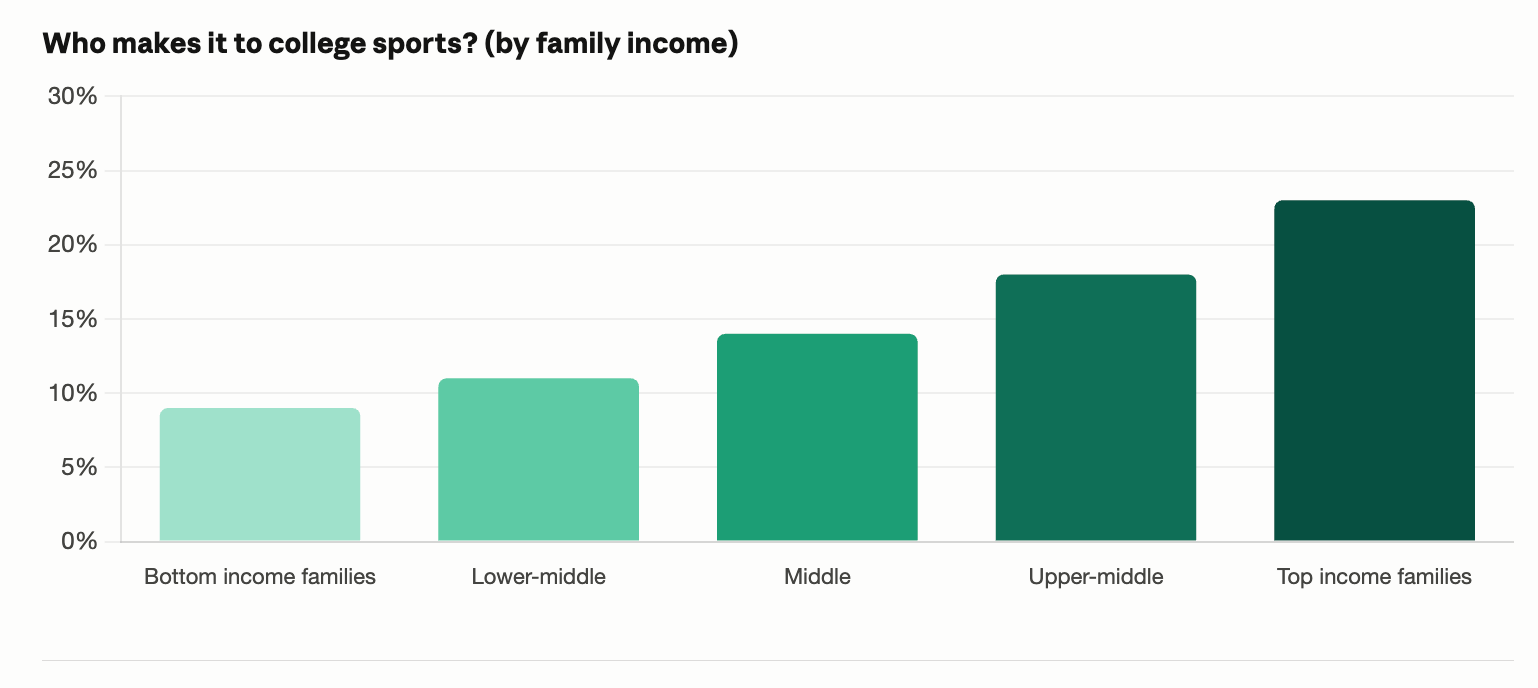
Back to the example statement, “it’s unfair that trans women join women’s sports,” this is a really weird statement of fairness, right? Because the data shows a pretty clear picture that genetics and wealth are key deciders in success.
Systems Critique forces me to disengage from the conversation that is inside the system, and first look at the system and see if I agree with the system.
This movement is so dear to me that it is the first article in my manifesto. Yes, I have a manifesto, haha. I believe that we all should adhere to a manifesto we took part in making. Think of it like a personal constitution, if you will. Because I live in America, I have to abide by the US Constitution, and because I’m Lana, I choose to also adhere to my manifesto. Here’s Article I:
Every frame I inhabit was built by someone, for something. My political instincts, my aesthetic preferences, my sense of what counts as “normal”: none of these are neutral. They are architectures with histories and beneficiaries.
I commit to asking, regularly and uncomfortably: what is this system optimizing for, and am I one of its inputs or one of its beneficiaries?
I will resist the seduction of systems that feel like liberation but demand my compliance. A new cage is still a cage, even when the bars are made of ideas I agree with.
So what does this mean in practice?
I think the examples above are great test cases for Systems Critique, but you can apply this to a lot, especially in today’s polarized world, from large-scale systems like the environment to niche theological debates. Let me give you some quick examples to finish this article up:
Large-scale system example:
You’ve all seen posts about how damaging data centers and AI usage are. But there are two Systems Critique points to be made there.
Eating a beef patty causes the earth to heat up more than the average AI queries per person.
Even if we all stopped using AI, we are not the main client. Corporations are the main client, so our impact is negligible. Unlike eating beef.
Theologically niche example:
Romans 1 is often used by conservatives as a proof text that homosexuality is a sin. Likewise, progressives argue that it’s not what the passage means. Both, however, fall in the same system. Both bring a courtroom to gay people, using Romans 1 as either a prosecution or a defense. Humbly, both miss the point.
To my conservative readers: Romans 1 is a rhetorical diatribe. Paul lists a list of vices that his audience would agree with, and then in Chapter 2 he says, and I paraphrase, “ironically, you are kinda judging yourself.” So no, my dear conservative readers. For argument’s sake, let’s say that Paul hated gay people. Well, this passage is not about gay people; it’s about you.
To my progressive readers: Romans 1 is a rhetorical diatribe. Paul is making no value statement about gay people. As a matter of fact, homosexuality as a term didn’t exist until it was coined by Karl-Maria Kertbeny to replace the more pejorative label “sodomite” (yes, sodomite is also a misnomer, and yes, that is also Systems Critique). He is just using a vice list as a tool.
If your interest is piqued, I expanded a little on this in a previous article. I also think I’ll outline a translation of Romans 1 next time to drive the point home. But instead of translating it word for word, I translate it using modern culture-war slang.
So, what about the “questions” posed to me as I prepared for a long awaited, heavily desired facial feminization surgery. In that moment, rather than giving in to the inner welling up of responding or joining in a debate, I tried to do Systems Critique first.
Because if the question is really a courtroom, then the most important move is not to give a better testimony. It’s to notice I never consented to the court. No jurisdiction. Case dismissed.