

Let's Rebuild
Enough with the renovations!


Hey Tripp,
I’m late to this one because of my recovery from surgery. Who knew that my facial feminization surgery would be more difficult to recover from than my bottom or top surgery? I somehow thought that I would be walking around normally after two weeks. But last week was my first pain-free week. A full seven weeks after surgery, yikes.
I finally got back to working out as well. When I stepped on the scale last week I weighed in at 180 lbs. I don’t think I’ve ever seen those numbers before on my scale. While I do like my body and am unbothered by weight, I do feel a bit heavier than usual, so I’m happy that I got my workouts in again.
Awkwardly, body physique and weight are dominated by men as well. Male bodies are optimized for, with tons of data to support it. Female bodies are an afterthought and in some cases forgotten altogether. It took until 2024 for the medical community to recognize that inserting an IUD is so painful that it warrants anesthesia. If female bodies are an afterthought in the medical community, then it comes as no surprise that trans and gender-expansive bodies are even more of an afterthought.
180 lbs may seem high for a 5’10” woman, but testosterone has made my skeletal structure larger than most cis women’s. Not heavy-boned, because that’s so marginal it’s not even considered a thing. But because of my longer bones, I carry more muscle mass, and therefore weight modifiers should be applied to me. But I have no clue what those modifiers are because we’re not studied.
But I’m running ahead of myself.
You were right to swap liturgy in for theology, and you were right that “all belong” is eschatological rather than present tense. What stayed with me, though, is what you did next. You took liturgy seriously enough as the work of our hands to walk it all the way down into the room itself: the acoustics, the height of the pulpit, the carpentry. You did with the building what I tried to do with scripture a few letters back. Let’s take this even further.
Bear with me as I’m drawing a parallel between the church and sports. I’m contemplative, haha.
Competitive sport was built the same way the sanctuary was, around one body that it called “neutral”: upper body strength, explosive power, higher oxygen carrying capacity, all traits men trend toward. Hardly “neutral,” right? And when that became untenable, sport did what liturgy is doing now; it just adjusted rather than rebuilt. Instead of naming that sport was built to celebrate one kind of body, and asking what games we would invent if it weren’t, we made a women’s league. Don’t get me wrong, I love women’s sport as much as the next person, but we also have to name that we just hired a carpenter to renovate the sanctuary rather than tearing it down and rebuilding it.
The worst part is that the fairness argument that supposedly justifies the segmentation doesn’t even survive its own logic. Eero Mäntyranta, a Finnish cross country skier, had a genetic mutation in his EPO receptor that gave him twenty five to fifty percent more oxygen carrying capacity than a normal body, and he skied home with three Olympic golds, no asterisk, no controversy, just legend. We tolerate enormous genetic inequality inside the men’s category without blinking, but what we don’t tolerate is a body crossing the boundary of the category itself. Olympic skeet shooting was mixed until Zhang Shan outshot every man in the field for gold in Barcelona in 1992, and the next year the International Shooting Union split the event by sex. Nothing about the sport had changed. A woman had won, once, in public, and that was enough.
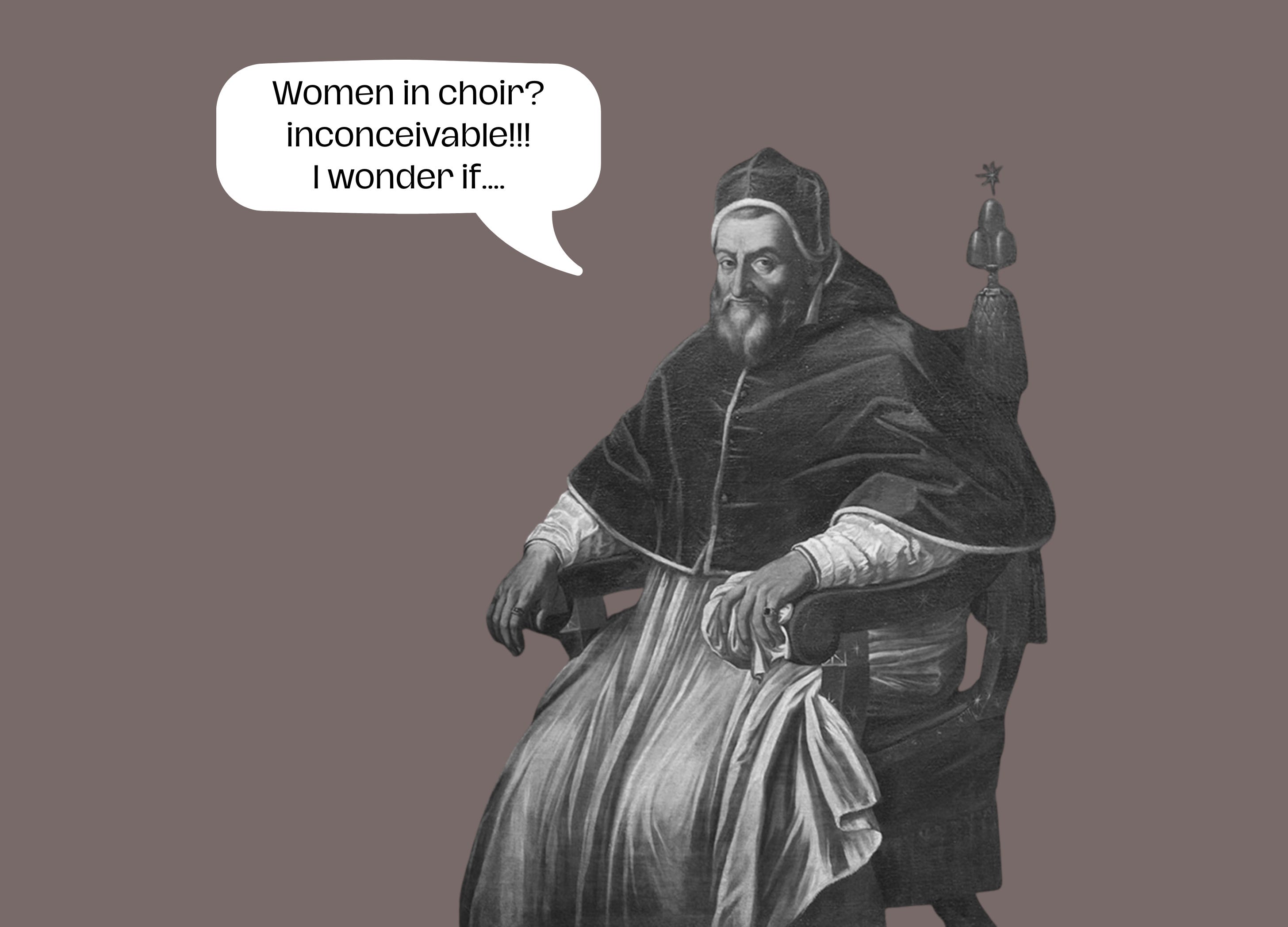
The church has its own version of this, and there are too many examples to list. You already named a few, so let’s stay in the choir loft. Sacred music wanted the soprano and alto register, but Sixtus V had barred women from singing back in 1588. So for three hundred years the solution was to castrate boys so they could produce that register artificially. When the practice finally ended in 1903, the fix was still boys, just retired once they hit puberty. I can’t wrap my head around the fact that we have found mutilating boys more thinkable than including women.
And we see a similar movement in ordaining women. On the surface it looks like the fix that finally worked, until you meet Kerlin Richter. Are you ready for another Pauline sentence? She was rector of a parish in Portland, ordained, doing exactly the work the reform said should now be possible, and when she told her bishop that she and her husband were in an open relationship, she was fired within the week and barred from her own congregation, and after a year of what she called an abusive disciplinary process she gave up her orders rather than keep fighting for them. The church solved the axis it was asked to solve, gender, and declared the architecture fixed. It was never asked to hold a woman who wasn’t monogamous, so it didn’t, and it still can’t, and Kerlin is standing in the part of the room nobody rebuilt; not fixed, not renovated, rebuilt.
My point is that “including more bodies in the existing structure” is the move that produced women’s leagues, ordained women, and boys’ choirs instead of castrati. I think it keeps happening because we’re just doing renovations. Every one of those fixes leaves someone standing exactly where Kerlin is standing. And where I’m standing: on a scale that has no numbers for a body like mine.
What does justice look like when we stop renovating? I’m thinking of our own Green Stormwater Infrastructure initiative. We noticed that water falling on our roofs was a problem, so we added gutters and downspouts to get the water away from our property as fast as possible. The problem was that by doing so we flooded our neighbors down the hill, overwhelming sewer systems and leaving vulnerable communities even more vulnerable. We just renovated our property and made our problem someone else’s problem. So I’m happy to see that our gardeners are now making rain gardens to soak up the water instead of sending it downhill. Of course, the Richmond sewer system was never designed for this many people either, so the city has rebuilding of its own to do.
Our rain gardens started as one line in a budget. So let me ask you something. You have standing at Richmond Hill; you said so yourself in your interview. Is there one specific, dated, budgeted thing, the pulpit, the choir loft, the polity that decides who gets to stay ordained, that you’d put your name behind moving this year? Not the apocalypse yet, just the one piece of furniture you actually have your hand on.
Lana
 | A guest post by
|