

Complicated Compliments
The Desexualization of Asian Men

A few years into my transition, Kim and I started talking about facial feminization surgery (FFS). I had held off on doing anything to my face because I wanted at least a few years to see how the hormones would recompose it. I also knew that there was a lot I liked about my face (I’m a cutie after all), and I was afraid that I wouldn’t recognize myself if I went in for surgery.
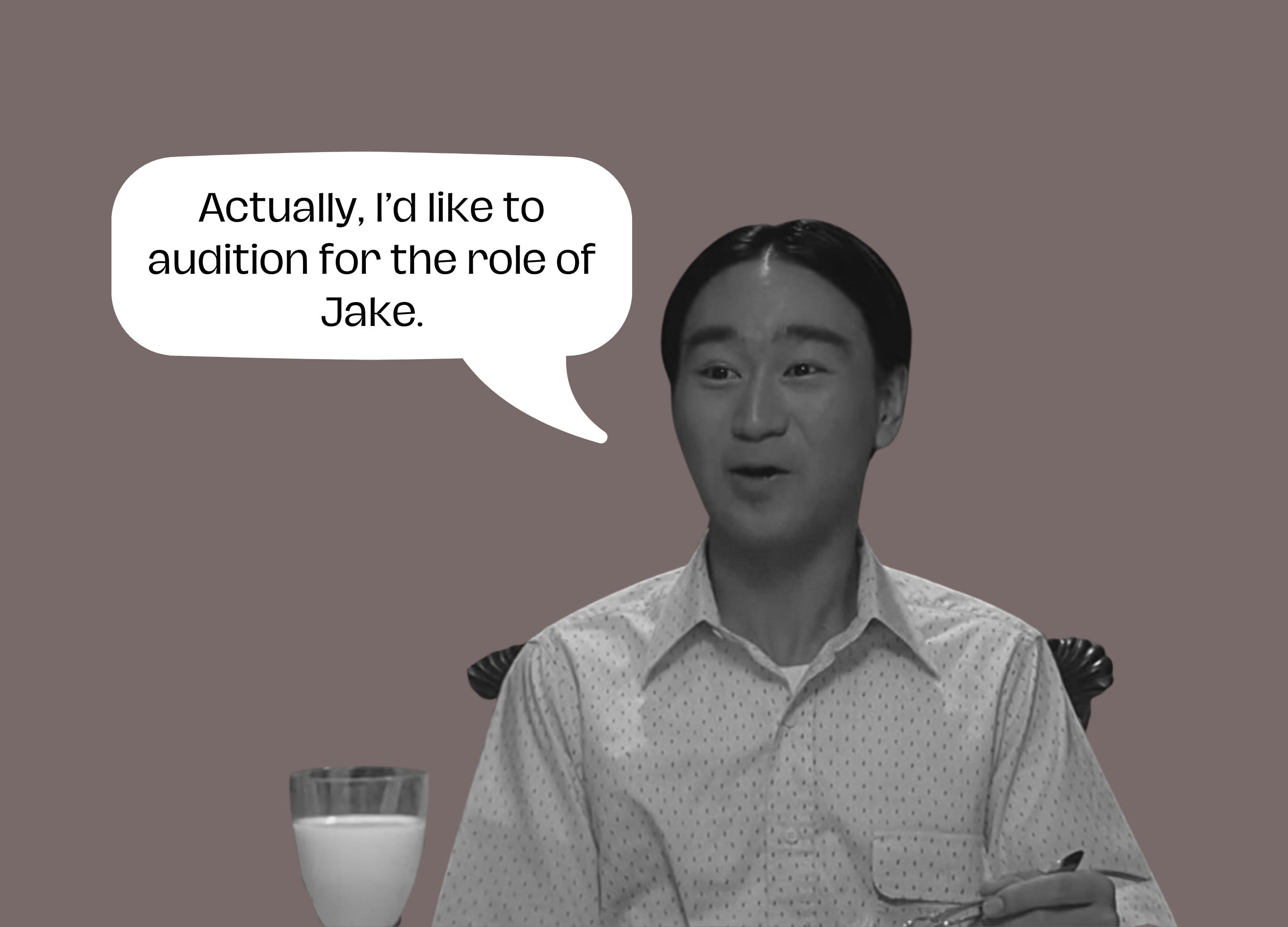
Dysphoria is terrible however, and it’s very hard to explain the pain that I felt. I remember a creator asking a conservative person, “What would you do if you had a brain transplant and they accidentally put you in a woman’s body?” and the guest answered by saying, “I’d do anything in my power to get back into a male body.” That story kinda stuck with me, because it’s the closest I have found to explaining how dysphoria feels.
Some nights I would grab my brow bones and curl up on the floor, feeling like they were pushing further out of my skull in real time. The difference between dysphoria and dysmorphia is that in dysmorphia you don’t see how your body actually looks. You may say “my shoulders look broad,” but in reality they are not actually broad. In dysphoria, you see exactly how your body looks, and it looks like someone else. Testosterone during puberty influences craniofacial bone growth, contributing to features such as a more prominent brow ridge, larger jaw and longer facial proportions. This masculinizing phenomena is hardwired into our brains. We don’t actively make that discernment, our mental models just take the conclusions for us.
And mental models do weird things to our minds.
One day I was visiting a very affirming church with my wife. This lady started talking with my wife and when I arrived she pointed at me and said “he.” This person knows I’m not a man but their brain’s mental models expect to see a man partnered to a woman because our culture has conditioned us to do so.
With trans women this gets even more complicated. I’m 5’10”, I have fewer curves, I have a lower voice, I have a gray cast on my chin, I had a higher hairline, AND I had protruding brow bones. Dysphoria is hard because it’s exactly those hundreds of small things that add up and beat us down every day. What makes it harder is that the mental models in people’s brains are hardwired to take shortcuts, so even the most well-meaning people (including myself) can’t help but make mistakes and misgender us.
Ok, so fast forward to November 2024, when I sat in a consultation room for FFS and told my surgeon that I don’t carry a lot of facial dysphoria. I wanted work done on my nose, my upper lip, and my brow bones, and I wanted his uncut professional opinion before we made any decisions. So I asked him directly what our society actually considers “feminine.” Honestly, it felt liberating to just talk about this candidly without having people in front of me do mental gymnastics to not hurt me. He pulled up my CT scans and told me that by Western standards, most of my features already read as feminine. Then he went one further. He said that faces like mine were the result of some of his best work on other, Western trans women. Or, put more bluntly, my skull, unmodified, was somebody else’s surgical outcome.
Yes, It was one of the more euphoric sentences anyone has said to me. But this particular euphoria had an aftertaste, so I had to follow it all the way down.
Three voices, one model
Three groups of people have told me things about my face, and they believe they are saying three different things.
The transphobes say I will never pass, that everyone can tell, that the bones don’t lie. Meanwhile the bones are the one witness they shouldn’t have called; my surgeon’s own measurements, the same skeletal criteria that whole industry runs on, come back reading “feminine.”
The racists, in their way, are the only ones who acknowledge my Asianness (awkward) without being asked. Growing up, I was never seen as quite masculine enough, and it told me where bodies like mine sat in the hierarchy of men. Let’s just say I have my fair share of stories about straight, White, male predators that used my body for their own purposes.
And the progressives, the people who love me, who use my pronouns, who would go to bat in my defense, say: “But you’re so feminine already. Why would you want FFS?”
I spent a long time hearing those as three different sentences, but in reality they are one sentence. All three read the same face through the same inherited model, a model that decided long before I was born what an Asian face is allowed to mean. The transphobe uses it to sneer, the racist uses it to rank, and the progressive uses it to be kind. The kindness is the same model underneath the sneer, and we should be suspicious of it.
The model was manufactured
So let’s get to the meat of it. The femininity of Asian men is an industrial product with a well-documented supply chain.
Start with law. In 1875 the United States passed the Page Act, which barred Chinese women from immigrating on the presumption that they were prostitutes; hyper-sexualization was written directly into statute. Seven years later the Chinese Exclusion Act cut off Chinese immigration almost entirely. The men already here were locked out of most labor markets and pushed into the work the economy had coded as women’s work: laundries, kitchens, domestic service. Denied wives by one law and “men’s work” by another, they formed bachelor societies, and then the same culture that had engineered that arrangement used it as evidence- Look at them, doing women’s work, living without women. How feminine. How deficient.
Then media took the baton and ran with it for a century. When Asian men were threatening, they were the villain: cunning and a peril rather than a person. When they were acceptable, they were Charlie Chan: deferential, aphoristic, sexless. When sentiment towards Asian men finally warmed up the industry corrected that error so thoroughly that the Hays Code era banned depictions of interracial romance outright; Anna May Wong could not kiss a white lead on screen, and Asian men largely could not be romantic leads at all.
Even the exceptions prove the design. Bruce Lee was allowed to be powerful only inside the exotic container of martial arts, a masculinity you buy a ticket to watch rather than one you might have to live next to, and he still lost the lead in the television show built on his own concept. By 1984 the culture was so overtly relaxed towards Asian racism they give us Long Duk Dong, a gong sounding every time he walked on screen with a “funny” name.
And the whole time, the same machine ran the mirror image on Asian women: lotus blossom, dragon lady, submissive, available, a fantasy calibrated for someone else’s consumption. The femininity assigned to Asian men and the hyperfemininity assigned to Asian women are one and the same thing. Asianness itself would be coded feminine, gendered as a race, so that white masculinity could remain the unmarked standard everything else deviates from.
But don’t take my word for it, because this has been extensively measured. Social psychologists call it “gendered race”: Galinsky, Hall & Cuddy find that Asianness sits closer to femininity and Blackness (read: black men are considered more aggressive and a threat) closer to masculinity in the American imagination. Johnson, Freeman & Pauker ran a test where participants had to quickly rate if a face is feminine or masculine and people were slower and less accurate categorizing Asian men’s faces as male. This solidifies the above by showing overlap operating at split-second face perception and not just questionnaire level.
The effects also show up in dating patterns, leadership selection, even which sports people are steered toward. OkCupid’s own data showed Asian men rated at the bottom of the desirability rankings by women of nearly every race, with Asian women rated near the top by white men. What’s happening here is called intersectional invisibility,* the finding that people who sit at the crossing of two categories become prototypical of neither and drop out of the picture entirely.
So when my surgeon told me my Indo features were already feminine by Western standards, he was not reading my bones. He was reading a hundred and fifty years of immigration law, casting decisions, and coded labor through my bones.
Intersectional invisibility: a term from social psychology (Valerie Purdie-Vaughns and Richard Eibach, 2008) for what happens to people who belong to more than one marginalized category at once: they fit the prototype of neither group, so both conversations proceed without them.
Who the model benefits
My habit, when a category starts doing this much unpaid labor, is to ask what it is optimizing for and who benefits. Unsurprisingly, It keeps white masculinity as the reference point and any other body is a deviation. This keeps desirability, and therefore social power, distributed accordingly. Systems generate faces to protect their load-bearing walls, and I mean that more literally than usual this time, because the face in question is mine.
This is why I am writing this for my progressive friends rather than for the racists or the transphobes. The racists and the transphobes are not confused about what they are doing. But when you tell me I’m “so feminine already,” I don’t think you are being cruel. You’re being conditioned, so much so that it comes out of your mouth as a compliment. You inherited it, the way we inherit all of it, and this model is of course happy to be inherited by kind people, because they give it its best disguise. A stereotype delivered as a sneer gets challenged and the same stereotype delivered as affirmation gets thanked.
There is a second cost hiding in the compliment, and it lands on trans people. “You’re so feminine, why would you want surgery?” quietly makes my access to care conditional on a deficit. It says surgery is for the insufficiently feminine, which means it re-derives the old gatekeeping logic that you have to suffer as an entry fee.
This is the same logic that I mentioned Matthew Vines used in his articles. By saying you’re “born this way” it also suggests that if you’re not born this way, it is justified to persecute you.
“We understand that you need facial feminization surgery because you look like a man” is basically the same sentence as “You’re so feminine, why would you want surgery?”
Now let me examine myself
I have been building a tidy case, and I don’t trust tidy cases, least of all my own, so here is the cross-examination.
First: the same model that spent a century emasculating Asian men is currently paying me. The coding that humiliated the men in those bachelor societies smooths my path through the world as a woman. The euphoria I felt in that consultation room was, at least in part, the system handing me a dividend. Am I standing in solidarity with Asian men, or am I citing their injury while cashing its check? I don’t think those are mutually exclusive, but I don’t get to pretend the check doesn’t exist.
Second: I have written before about declining courtrooms, and here I am, entering skeletal evidence into the record like a good defendant. While in reality these measurements are a delicious irony and a terrible foundation, and I am allowed to laugh at the first while refusing to build on the second.
Third: my own thesis restates the stereotype it critiques. Asian men are not actually feminine. Asian faces are not actually anything. My face is not evidence about Asian people, and I should be exactly as suspicious of the sentence when it produces my euphoria as when it produces someone else’s shame.
Fourth, and most personally: I am Indo, mixed Indonesian and Dutch, light-skinned, and Americans regularly tell me I don’t look Asian at all. Which is funny because I am not Asian enough to count, but Asian enough to be pre-feminized. The category door swings depending on what the room wants to do with me. I am seen selectively, in whichever way requires the least revision.
And fifth: an article like this can become its own abstraction layer. I can perform the seeing of the system, collect the credit for seeing it, and change nothing about how I move through it (there’s a Substack business model for you). The test of this piece, however, should be whether anything downstream of your mouth or mine actually changes.
Keep the compliment
“You’re so feminine, though.”
I know.
The sharpest slur ever engineered against Asian bodies and the sweetest thing you say to me are the same thing, and neither one is about me. Before the next compliment about anyone’s body leaves your mouth, give it one breath of hesitation, one flicker of asking where the sentence was trained. I will take that breath over a century of inherited kindness every time.