

A Response to Rev Tripp
Because our conversations are too cool to be held in private


Dear Tripp Hudgins ,
I’m doing pretty well. More like irrationally well because of this perfect weather. Winter doesn’t affect me too much because I thrive in the cold, but when spring hits, some hormones in my body make my world so rose-colored. Ask me again next time. The rest of the family is well too, besides some lingering coughs from winter colds and spring allergies. The state of my heart though… that’s a pretty deep question. Let’s just say it feels more settled now than it has been in a while. I feel like I’m going through some existential dread and, honestly, I wouldn’t want it any other way.
How about you? How are you, your family, and your heart?
You’re right that Richmond Hill could (could, not is, I’ll explain later) be a brave space, and I want to affirm that before I complicate it, because the complication only matters if the affirmation is real. But Richmond Hill is a complicated place. A while back I wrote about meeting God in the unexpected. I feel so deeply connected to the ground that Richmond Hill is built on. Every time I’m walking around there’s something magical that draws me in. That being said, working in person at such a... I don’t even know what to call it... deeply traditional place has its challenges. I’m pretty used to online hate and dismissal but receiving it in person hits different.
I was just talking about this with my friend Kiry. It is unreasonable to ask of me to advance trans, queer, women’s, and racial rights because those are all my intersections. And at the same time, who’s better equipped than someone like me to highlight the systemic injustice that’s happening to my staff and myself? It certainly is not my job, but I feel called to do it anyway.
Then this stat came out last week:
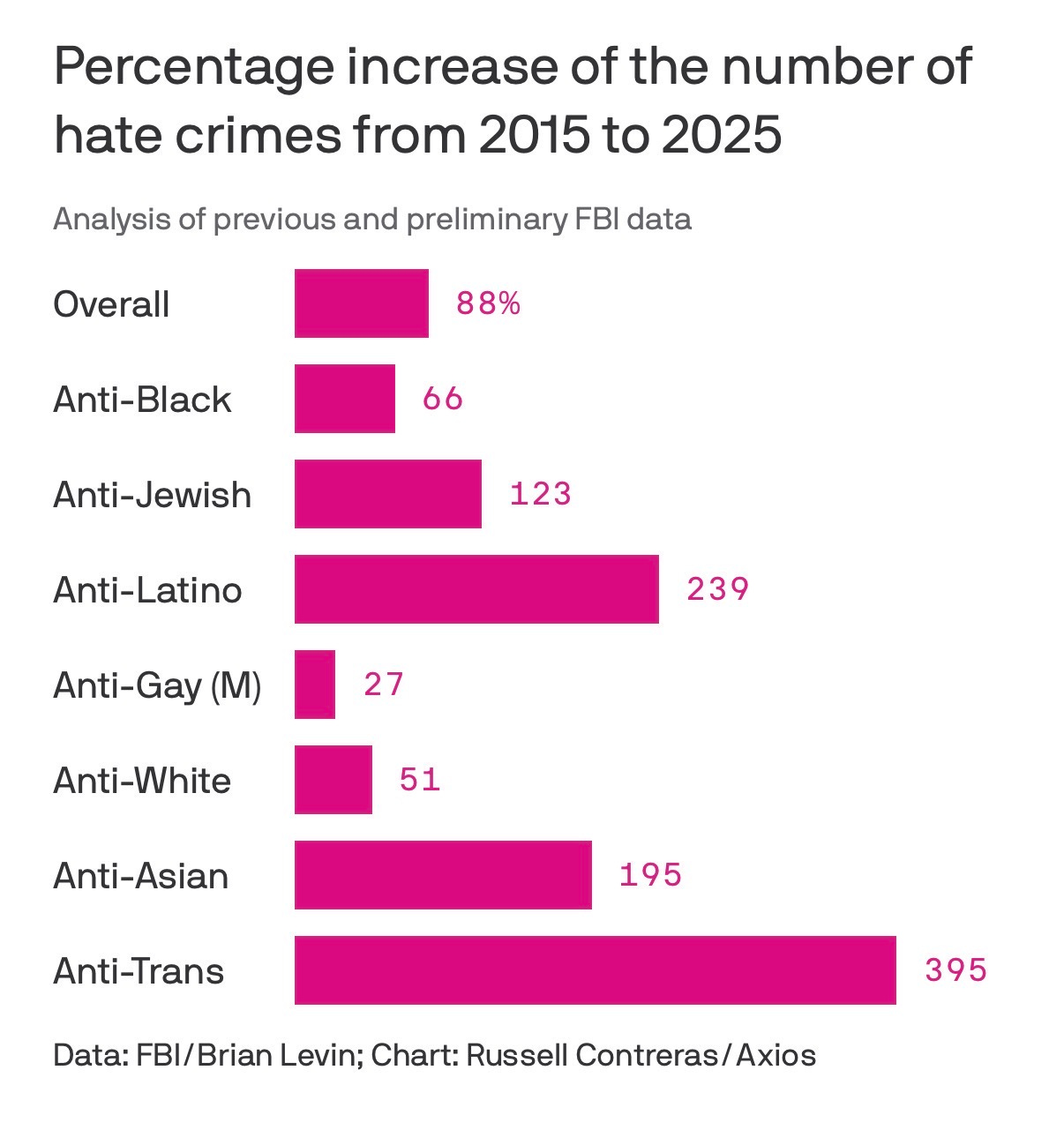
One observation is that between 2015 and 2025, America has become more hateful. Another observation is that I embody three of the top four categories. There is an innate danger to being on the front lines while holding so many identities. But if it weren’t for Marsha P. Johnson, Yuri Kochiyama, or Abraham Heschel, I wonder what place there would be for me here in America.
Marsha P. Johnson taught me that when the entire world is against you, mutual aid is our lifeline. Yuri Kochiyama taught me that even when the literal walls are closing in, we can still see hope. Abraham Heschel taught me that when other intersectional identities suffer, we too suffer.
However, I didn’t choose to enter a brave space. I am the brave space. My body is the thing the institution is practicing its bravery on. When I walk into the building, I feel a particular kind of attention that I have learned to recognize. It’s not hostile. It is almost never hostile. It is closer to watchful: the micro-adjustments people make while they figure out what to do with me, the slight recalculation before someone chooses a greeting. I am not being rejected. I am being processed, and that processing is its own form of labor, quieter than rejection but cumulatively just as heavy.
You said Richmond Hill has been closeted in its own way for decades, and I think you’re exactly right. But institutional closets operate differently from personal ones. When a person comes out, they take the risk onto themselves. When an institution comes out, the people inside it who are already visible become the evidence the institution points to as proof of its own progress. That can be honoring. It can also be a kind of exploitation, and the difference between the two depends entirely on whether the institution is willing to name its own sin alongside the visibility it’s claiming.
This is where your twelve-step framing hit me hardest. You’re right that it’s foundational to Richmond Hill’s theology. God rescues us from what we cannot rescue ourselves from, and the work begins with naming the specific thing that has us in its clutches. Richmond Hill did that around race, imperfectly and genuinely, and the imperfection didn’t disqualify the genuineness. The question is whether we can extend that same surrender to include our ignorance about queer bodies, about trans bodies, about my body specifically, while still holding our awkward relationship with race.
The sin we would need to confess isn’t primarily overt hostility. We don’t have much of that. The sin is something harder to name, which is why it persists. It is the studied not-knowing (mental models), the way that genuine warmth can coexist with a refusal to ask the questions that would make things uncomfortable. Richmond Hill has been very loving toward me in ways that stop just short of full recognition. I feel that gap. I believe God does too.
Your intersectionality point is the one I keep returning to. The twelve-step model for racism worked because it named one sin. But liberation is not singular. To name only racial sin while leaving gender, sexuality, and gender identity unnamed isn’t just incomplete; it is a form of the same structural avoidance we are trying to repent of. The mission of Richmond Hill is racial reconciliation, and I believe that with my whole heart, and I also believe that a liberation theology that cannot name my body is not yet finished. These are not competing truths. The second one is what the first one requires.
Richmond Hill’s willingness to make racial reconciliation its mission is only saying yes to a very long journey that will never end. It’s acknowledging that when it comes to black bodies, white people can never be the ones to lead that charge. While those white people are asked to step aside to make space for black bodies, they are also gently reminded that it is their job to openly protect those same black bodies.
Racial reconciliation is therefore implicitly connected to trans liberation, i.e., without racial reconciliation, there can’t be trans liberation.
I want to write the confession with you. Here is what I would want it to name: not just the sin of active bigotry, which is the easy one to confess and the least present among us, but the sin of performing welcome while protecting the structures that make welcome conditional. The sin of loving people in ways that stop just short of full recognition. The sin of letting the most visible people carry the institutional courage while the institution itself waits.
I do want to point out for our readers that when I use the term “sin,” I mean “missing the mark,” as in missing the mark of your destiny. Which can look different for every faith expression.
I like the bones of your prayer. I’m drawn to language that states that “we have denied your goodness in each other,” which directly speaks to the exclusion of bodies like mine. Excluding me from the table is excluding what God made.
I don’t like the idea that everyone can say the phrase “we repent the evil that enslaves us.” Chattel slavery was widespread in Indonesia until the 20th century and, according to walkfree.org, an estimated 1.8 million Indonesians still live in modern slavery. So I don’t know how I feel about people without a history of slavery or indentured servitude reciting those words. I’d be interested to hear what descendants of those enslaved in America have to say on this topic.
For those who are reading my work for the first time: I’m Indo. This means that my mother is Indonesian and my father is Dutch and white. Mixed-race Indonesians had a particularly interesting history of racial injustice as they always got grouped together with the oppressed. By the Dutch, we were seen as “exotic” and when the Japanese invaded Indonesia in WWII, Indos were placed in concentration camps together with native Dutch people.
I would also be interested to see what a merger of the confession of sin in Rite II would look like with the Episcopal confession that you posted. I especially like the phrase “by what we have done, and by what we have left undone,” which directly speaks to the mental models underlying the sin of exclusion.
Most merciful God,
we confess that we have sinned against you
in thought, word, and deed,
by what we have done,
and by what we have left undone.
We have not loved you with our whole heart;
we have not loved our neighbors as ourselves.
We are truly sorry and we humbly repent.
For the sake of your Son Jesus Christ,
have mercy on us and forgive us;
that we may delight in your will,
and walk in your ways,
to the glory of your Name. Amen.
In Judaism, we reserve part of our liturgy for the Amida. It’s a collection of 19 prayers that has a structure of 3 praise blessings, 13 requests, and 3 thanksgiving blessings. The sixth prayer is called “סְלַח לָנוּ” (S’lach Lanu). It states:
Forgive us our Father for we have sinned,
pardon us our King for we have willfully transgressed,
for You pardon and forgive.
Blessed are You, O Lord,
Who is gracious and ever willing to forgive.
Besides the gendered language, I like the explicit mention of our willful transgressions. In the same article you quoted, I make a point of saying that we are creating abstraction layers. We tend to vilify just one evil so we don’t have to look at the other atrocities we commit daily.
We chant “free Gaza” without chanting “Free Nagorno-Karabakh.” We demand an end to the mining of cobalt in the DRC without demanding an end to the mining of nickel in Indonesia. We criticize the use of AI in water units, while eating one beef patty emits as much CO₂ as tens of thousands of AI queries.
The problem is that we latch onto one objective evil (Gaza, DRC, or AI) and utilize that as an abstraction layer to distance ourselves from the other effects our lives have. When we put on eyeshadow with mica, little children die in the mines of Jharkhand and Bihar; when we water our lawns, communities go thirsty; and when we post this Substack, we devastate communities in Inner Mongolia.
Consistently acknowledging our willful transgressions is a hard prayer. It is also a genuine one.
With love,
Lana
 | A guest post by
|
The most meaningful line in the Episcopal confession for me was the line that seems not used. It follows “and by those sins undone. It was “and there is no health in us.” It confirms that sin is indeed a disease of the heart and of the soul.
Another thing about communities that I've learned, having lived in several, is that there is a natural insularity to any right community that makes it hard for outsiders of any stripe to enter without an invitation. And being in a social category that is defined as "other" makes an additional struggle.
I'm a quiet sort of ND queer myself and I was trained to "blend in" from an early age. Outing myself is a recent project and it takes work. The idea of making other people uncomfortable kinda scares me. Being overtly cis-het-male, I'm deeply conditioned that "making people uncomfortable" is very strictly forbidden to me.
Taking awkwardness onto myself is a burden I've just taken as my due in life. Hospitality to strangers is something any community needs to do *intentionally* and all the more when you're providing to the "strange" among us. And note that I'm not scared of strange folks. It's "normal" that tends to make me nervous.
Thanks for your thoughts, dear stranger on the internet.